Beyond Compliance: The Real ROI of Meeting Building Performance Standards
Owners who treat compliance-awareness as a planning advantage, rather than a regulatory burden, are positioning themselves to protect and grow asset value in the decade ahead.
Since their inception, Building Performance Standards (BPS) have been treated as a future problem. Owners have deferred plans to address them until enforcement became clearer, once our political fates settled, or once a sale or financing felt close enough to justify the effort. That window has closed. Across every major BPS market, the impact of these policies is starting to show up in underwriting, in due diligence requests, and in the way buyers compare assets.
All along, the real risk of non-compliance has not just been about the year-over-year operating impact. Fundamentally, it has been about how performance relative to peers reshapes value. Two similar buildings in the same market can diverge dramatically in pricing once BPS-driven risk, implied deferred capital exposure, and retrofit feasibility enter the discussion. One owner has evaluated options, mitigated the fines or built a credible, incremental plan. The other hasn’t. That difference is now enough to drive discounts at the negotiation table.
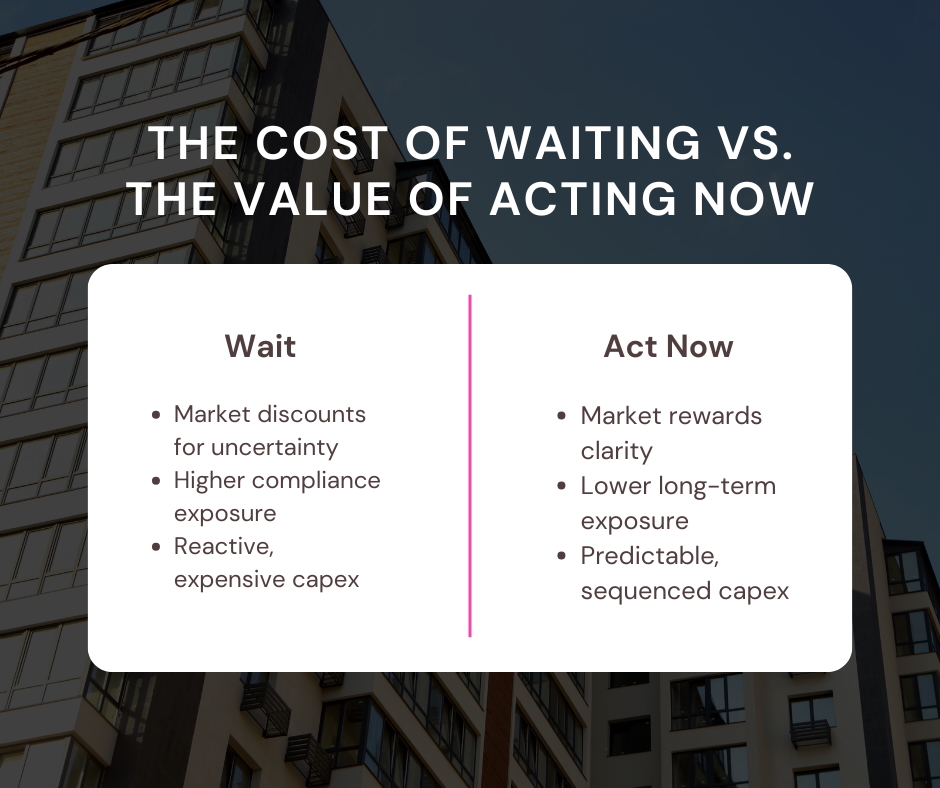
The real ROI of BPS sits inside this widening value gap. Early movers are turning compliance needs into a planning advantage, converting regulatory pressure into incremental, manageable, and predictable capex, creating stronger positions in a tightening investment landscape. Late movers are discovering that waiting only shifts costs downstream, where they show up as price chips and tougher conversations with investors.
This is the landscape that owners and investors are heading into for 2026.
The Market Has Shifted From “What’s Going to Happen?” to “Who’s Prepared for what Will?”
BPS is often misunderstood as a compliance issue, like a building code: a building either meets a requirement or it doesn’t. In practice, these policies serve a different purpose. Buyers, lenders, and investors are now able compare buildings against their peers, weighing relative performance and compliance costs against revenue potential and exit opportunity.
If your nearest comparable asset has addressed its penalties or built a validated pathway while yours has not, the difference isn’t theoretical. It shows up immediately in underwriting. Markets reward clarity and penalize uncertainty, and BPS has become a reliable proxy for the future sentiment of markets with respect to energy and carbon.
This context is especially important given the cohort of owners who still believe these standards may lack teeth. Some expect weak enforcement, others assume political shifts will reduce fines. We’re seeing that the market is no longer waiting for perfect policy signals, and buyers have already integrated BPS exposure into their underwriting model.
The result is a bifurcated market: with one group acting on the assumption that BPS risk is real, and another holding onto the belief that the consequences will be soft. Buyers have no incentive to align with the first group when the second allows them a discount on entry.
Buyers Are Already Underwriting BPS, Regardless of Politics.
We see this directly in Audette’s due diligence work. Acquisition teams are asking for BPS scenarios, projected fines, retrofit timelines, and asset-level cost models. They want to understand exposure before they bid, and they are discounting for uncertainty even when sellers insist the risk is overstated.
Their logic is straightforward. Energy costs are rising, systems are aging, and tenants expect comfort and stability. Policy timelines are far enough along that “wait and see” is no longer a viable strategy in underwriting. Whether fines are enforced on day one is less important than whether a building is prepared for the trajectory the entire market is moving toward.
This creates a clear disconnect: an owner may not believe BPS will be fully enforced, but a buyer is incentivized to do so. Pricing follows the buyer’s belief, not the seller’s comfort level.
This is why disbelief offers no protection. Preparation does.
Where Early Movers Are Pulling Ahead
As buyers adjust their assumptions, early movers are showing that compliance, when handled proactively and incrementally, becomes a strategic advantage rather than a cost center. Several patterns are emerging across leading portfolios.
1. Predictable capital planning becomes a financial asset
BPS timelines force owners to look ahead. Those who engage early can sequence upgrades around natural equipment cycles, secure incentives, and avoid rushed, expensive retrofit projects. In a market where capital is tight, predictability becomes as valuable as savings.
2. Resilience becomes a visible part of the asset’s story
A building with reduced exposure or a validated plan is simply less risky. Investors and lenders reward that certainty. Even partial mitigation strengthens a building’s standing within a portfolio or fund.
3. Compliance signals quality to tenants and capital partners
Future-ready assets differentiate themselves. Tenants prioritize comfort and system reliability. Institutional capital prioritizes transparency and risk alignment. BPS readiness becomes part of the narrative that signals a well-managed building.
Taken together, these advantages frame BPS not as a cost, but as a framework for better long-term asset management.
The Technical Reality: Every Building Has a Different Starting Line
One of the most underappreciated aspects of the energy transition is how uneven the retrofit landscape truly is. Two buildings with similar size, age, and use profile can have entirely different compliance pathways. HVAC configuration, envelope condition, ventilation strategy, utility service constraints, and operational patterns all change the cost and complexity of meeting standards.
This is where owners often underestimate their risk. Without accurate analysis, it’s easy to assume a building is “typical” when its technical profile actually places it at a disadvantage—or, in some cases, makes it easier and cheaper to address than expected.
Expert support becomes essential because technical precision translates directly into financial integrity. When owners understand the real starting point of each building, they make better decisions about sequencing, capital planning, and portfolio-wide prioritization. When they don’t, they run the risk of modeling pathways that are out of sync with physical reality.
Audette sees this regularly in due diligence work: some assets face significant modernization needs; others require only targeted measures. The differentiation is not visible without disciplined engineering analysis, and in a market where buyers are scrutinizing exposure, guessing is costly.
Turning Compliance Into a Value Lever
The ROI of BPS becomes clearer once owners recognize that the work required for compliance overlaps with broader financial health. Energy-efficient and modern systems reduce price volatility. Better-performing buildings experience fewer comfort complaints and system failures. Pathways that avoid fines also create NOI, and transparent, documented actions increase buyer confidence because they reduce uncertainty around future spending.
In other words, the benefits compound. They show up in:
- Lower energy price risk
- Steadier operating budgets
- Stronger bids at disposition
- Higher partner trust
- Reduced turnover from comfort issues
- Fewer last-minute capital surprises
When owners treat BPS as a strategic framework rather than a checklist, compliance becomes a financial tool.
What Portfolios Need for 2026
Heading into 2026, the market is moving toward greater sophistication. High-level sustainability commitments no longer carry weight. Portfolios need:
1. Standardized, comparable models across every building
Buyers expect consistency. Static reports and ad hoc audits don’t deliver it.
2. Plans that refresh annually as policies and markets shift
Regulations evolve. Incentives change. Equipment pricing moves. Pathways must adjust accordingly.
3. Shared visibility across sustainability, asset management, and acquisitions
When each group sees the same technical and financial truth, the execution gap closes. ESG leaders gain credibility. Asset managers gain clarity. Investors gain transparency.
These capabilities are becoming the baseline for market-ready planning.
Conclusion: The Gap Isn’t Between Compliant and Non-Compliant. It’s Between Prepared and Unprepared.
BPS no longer sits on the sidelines of asset strategy. It is shaping how buyers price risk and how portfolios protect value, and is a proxy for how broader markets will behave. Early movers are already stabilizing operating costs, strengthening NOI, and increasing confidence with investors and lenders. Late movers are discovering that waiting doesn’t avoid the cost, only shifts it to a moment when pricing power has moved to the other side of the table.
The energy transition is rewriting the rules of real estate value. Buildings that navigate with clarity and technical precision will outperform those that wait for certainty. Owners who treat compliance-awareness as a planning advantage, rather than a regulatory burden, are positioning themselves to protect and grow asset value in the decade ahead.
If you want to understand your BPS exposure and build a plan that protects value, get in touch with our team here.

Decarbonization as a Value Driver, Not a Cost Center
Galvanize Real Estate shows how decarbonization can drive returns—not just meet regulations—by baking it into every deal from day one.

How future-proofing assets can create and drive markets
This newsletter explores the evolving impact of building performance standards (BPS) on real estate, highlighting their role in driving decarbonization and reshaping asset management strategies. It provides actionable insights on compliance, retrofits, and resilience to help property owners and managers navigate this transformative regulatory landscape in 2025 and beyond.


Beyond Compliance: The Real ROI of Meeting Building Performance Standards
Owners who treat compliance-awareness as a planning advantage, rather than a regulatory burden, are positioning themselves to protect and grow asset value in the decade ahead.

Rewriting the Retrofit Playbook: How Value-Accretive Decarbonization Protects Asset Performance
How reframing the energy transition around capital planning, valuation, and risk will define the next generation of real estate leaders.

How to Talk About Energy & Carbon Transition in a Real Estate Cash Flow Model
By making decarbonization an integral part of financial strategy, Audette helps real estate portfolios move beyond ambition and into execution.

Behind the Curtain: How LP Pressure and GP Collaboration is Accelerating Real Estate Decarbonization
Inside insights from Audette’s panel at the IMN ESG & Decarbonization Forum on how LP mandates and GP structures are shaping real estate decarbonization.

Why Resilience Must Be Central to Every Real Estate Investment Strategy
Real estate leaders Lauren Zullo and Thomas Stanchak join Audette CEO Christopher Naismith to explore how resilience and decarbonization intersect in real estate investment. They share strategies for aligning capital planning with climate risks, overcoming internal barriers, and driving long-term value through sustainable practices.

Unlocking Value Through Decarbonization: Lessons from Galvanize Real Estate
Galvanize Real Estate proves that decarbonization isn’t just good for the planet—it’s smart business. By treating deferred maintenance as a financial opportunity and embedding sustainability into core strategy, they’re showing how CRE firms can cut emissions and boost returns.

The Opportunity in Resilience—Why Physical Risk Mitigation is More Than Just a Cost Center
As insurance markets pull back from high-risk areas, real estate value is shifting fast. This blog explores how physical risk mitigation is becoming essential—and why it’s a strategic advantage, not just a cost.

Navigating Change: Finding High-ROI Opportunities in Decarbonization
The financial landscape of decarbonization is shifting. Companies that act now will secure long-term ROI, while those who delay will face growing financial risks.

The Impact of Building Performance Standards on Asset Value in North America
Building Performance Standards (BPS) are reshaping real estate investment. Learn how asset managers can leverage BPS to protect NOI, boost valuations, and stay competitive.

Shaping a Sustainable Future: Decarbonization Planning in Real Estate
Decarbonization is transforming real estate by shifting the focus from energy efficiency to long-term, sustainable strategies. This blog highlights insights from industry leaders on creating actionable plans, leveraging standards like LEED v5, and driving value through brown-to-green investments. Learn how to align your portfolio with net-zero goals and lead in a low-carbon future.

Driving actionable net zero plans in multifamily real estate
Multifamily real estate faces unique hurdles in the shift to decarbonization. From managing decentralized energy systems to tackling split incentives, it's not just a matter of if—it's about finding the how. Discover how industry leaders are turning complex data into actionable, scalable strategies for a net-zero future.

The three pillars of a scalable decarbonization program
A guide to building a strong decarbonization program in real estate, focusing on efficiency, capital planning, and organizational alignment.

IMN recap: From decarbonization talk to action
Key takeaways from IMN's ESG & Decarbonizing Real Estate Forum: Three best practices for achieving tangible decarbonization outcomes in real estate

Payback is dead, long live payback
Traditional ROI models in real estate often miss the mark by focusing only on short-term utility costs. Discover why a broader perspective on value creation and protection is crucial for effective decarbonization efforts, with insights from industry leaders.


Future-proofing assets: Managing transition risk to protect value
Join Jonathan Rose Companies and Stoneweg as they apply a transition risk strategy to preserve asset value.
Dirty-to-clean value-add strategies with Galvanize Real Estate
Learn how Galvanize Real Estate ties capital planning decisions to long-term asset performance.
Underwriting retrofit decisions during acquisition
Join Madison International Realty and Crown Realty Partners to discuss retrofit economics and due diligence.
How real estate standards affect asset value and decisions
Join GRESB, USGBC, and Ember Strategies to learn how standards influence capital allocation and asset strategy.
Multifamily retrofit strategy: navigating risk and return
AvalonBay and Greystar share how energy market shifts are shaping multifamily portfolio strategy.
How carbon exposure is beginning to affect asset values
Tishman Speyer and Lendlease Americas break down how carbon and ESG trends are already shaping asset values.