IMN recap: From decarbonization talk to action
Key takeaways from IMN's ESG & Decarbonizing Real Estate Forum: Three best practices for achieving tangible decarbonization outcomes in real estate
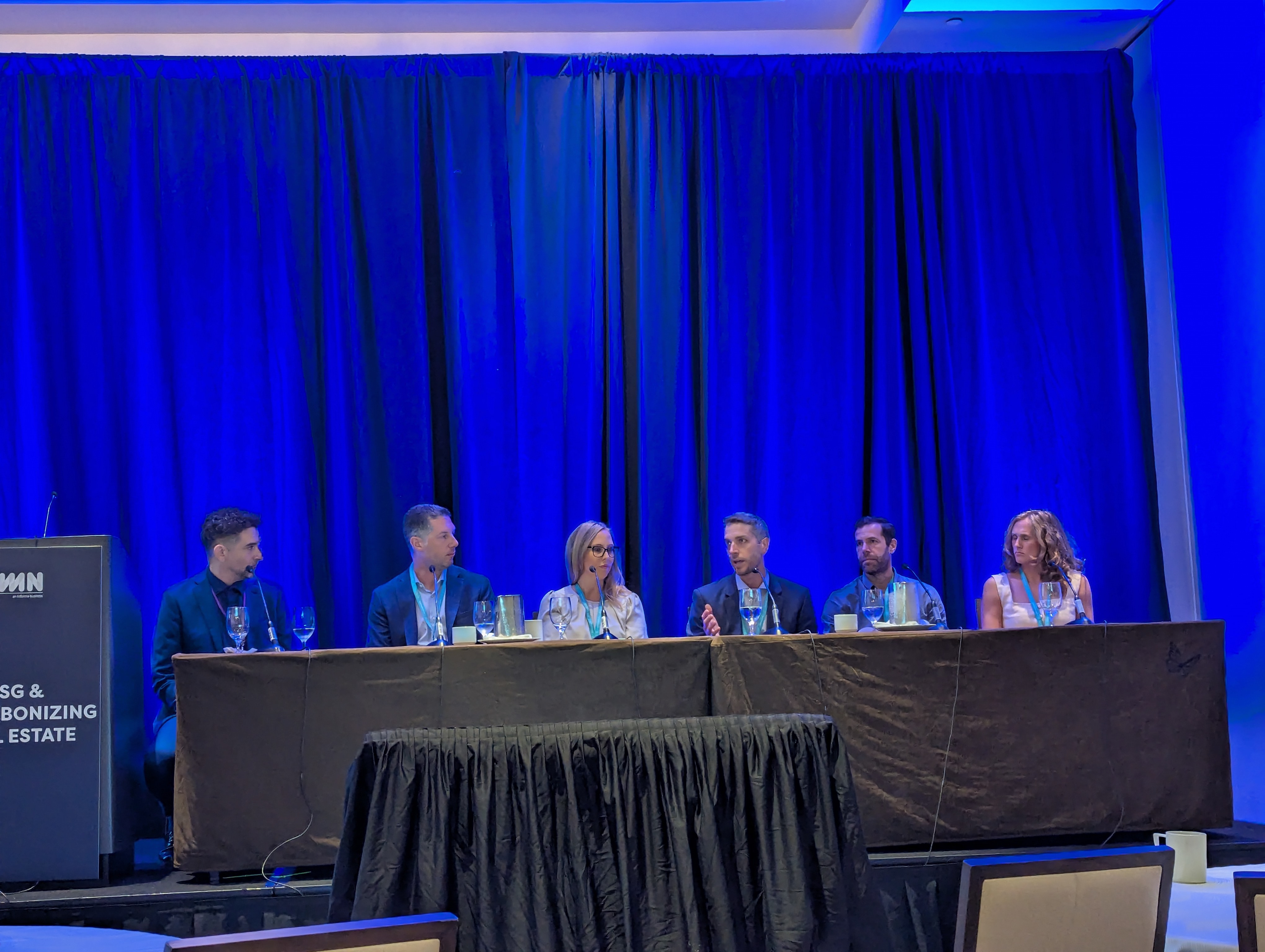
At IMN’s recent ESG & Decarbonizing Real Estate Forum, our founder Christopher moderated an expert panel on Taking Decarbonization from Talk to Action, covering the challenges of building a decarbonization business case and strategies to gain organizational alignment.
Christopher was joined by:
- Zach Brown, Director of ESG for the Americas for PGIM Real Estate.
- Chris Laughman, Senior Director of Energy and Sustainability at Greystar
- Jaime Birman, Director of Development and Construction for Orbach Affordable Housing Solutions
- Keely Felton, Chief Sustainability Officer at Nova Group, GBC
- Charlie Christensen, VP of Engineering at STOK
The three best practices for seeing tangible outcomes at their organization?
- Just Do It
- Build an Actionable Business Case
- Speak the Right Language
Let’s dive into these below.
(Missed the conference? Go behind-the-scenes at IMN with us.)
__
1. Just do it
Don’t let perfect be the enemy of good, and don’t let comprehensive data collection block you from taking action. Yes, collecting some amount of basic property-level data is critical to get started on your decarbonization journey, but too many people get caught up in the data collection itself, instead of remembering the end goal of collecting that data — driving carbon reduction.
This was a major theme at the conference, including on the Less Reporting, More Reduction panel, which took place before Taking Decarbonization from Talk to Action.
“Data is a huge challenge,” Daren Moss, Principal, ESG of Real Estate at Ares Management, said during the reporting panel. “Instead of collecting everything, we focus on what we’re doing to drive decarbonization.”
In software, we talk about ‘minimum viable product’. In decarbonization, we should think about minimum viable data—you don’t need all the data, and you don’t need perfect data. You need enough of the right data and estimations to be directionally accurate as you move forward.
“We've purposely, particularly this year, put a lot of emphasis into different types of quality control to make sure the data's right in the first place so that we make informed decisions,” Chris said. “If we make decisions on bad data, it's downhill from there.”
When considering decarbonization, your primary goal is to make sure that whatever fuel you’re consuming (no matter how much you’re consuming) is of the lowest carbon intensity possible. Thus, the important data to get right is what types of fuel you’re using (fuel mix), what systems are using it, and what the right replacement is for each of those systems.
“Don’t let perfection inhibit progress,” Keely said. “You don’t have to do 100% electrification right away. You don’t have to do it all at once.”

What does getting started look like?
There’s nothing wrong with starting with the low-hanging fruit projects (LED lighting being the most common we see) — they can help start the flywheel of progress and demonstrate the value of decarbonization to your internal stakeholders without requiring a significant investment.
“We’ve all changed to LED light bulbs,” Charlie said. “How many more fluorescent or incandescent lights are still left out there? The challenge seems to be the medium-hanging fruit and the high-hanging fruit, the things that are going to be very impactful.”
Some times, particularly in California, owners may already be sitting on all electric assets that will decarbonize naturally with the grid. But in most cases there’s a growing recognition that low-hanging fruit will only get you so far. It’s not going to get your portfolio to zero carbon, or even the majority of the way there. We’ve seen (and developed) hundreds of transition plans, and the hard truth of the matter is: decarbonization is expensive. There’s no getting around it. To drive material carbon reductions, you will need to fund and implement more capital-intensive retrofits.
You can ‘just get started’ by prioritizing a few of these bigger-ticket projects, implementing them, measuring their impact, and proving their value to your organization.
2. Build an actionable business case
To get your projects approved and funded, you will need to build a strong, data-driven business case for decarbonization.
We have covered this extensively in our webinar series and many of the same themes were underscored at our IMN panel. Building a successful business case for decarbonization is critical to achieving your reduction targets —but it has its challenges. The traditional simple payback model, which focuses only on savings, fails to capture the more holistic value created by decarbonization.
So what’s a sustainability leader to do? Focus on value creation and value protection.
“What's really been working for us is to lean into this assumption that a decarbonized building is going to be more valuable, whether it's tomorrow, whether it's next year, whether it's five years,” Zach shared of his work at PGIM, one of the world’s largest asset managers.
We can see the opportunities driving that value from market forces and impending regulations. The demand for low-carbon office spaces is expected to far outstrip supply by 2030, leaving 70% of demand unmet, and low carbon real estate is already securing a green premium of 7.1%. The numbers speak for themselves.
So do the regulations. The building performance standards expected to roll out in nearly 50 jurisdictions across the US were the hot topic of another IMN panel, Building Performance Standards: Is This Really Going to Happen. While we are still early in seeing evidence of brown discounts play out in the US (vs. Europe), the destruction of asset value due to failure to responsibly decarbonize is no longer a question of if. It’s a question of when.
For many of the speakers at IMN, who manage some of the world’s largest funds and portfolios, incorporating fine avoidance (i.e., value protection) has been a critical part of building out the business case for decarbonization.
“There is a real possibility of a brown discount applying to properties whenever we don’t take into account the fines that may result from not meeting local rules,” Chris said, citing that existing regulations impact thousands of properties within Greystar’s portfolio. “it's a real, real possibility that I'm going to have to discount the sale of a building at some point in one of these jurisdictions if I don't take into account the fines it's gonna face.”
Stranding risk, as tracked by CRREM, is another framework to help real estate owners quantify asset value at risk due to carbon and aid them in building strong business cases. Though it’s well-established and utilized in Europe, CRREM is still relatively new in the US and Canada, with the CRREM North American Working Group working to adapt the methodology for these markets.
Zach and PGIM were early adopters of CRREM. “It’s one of the best tools that we have for a truly consistent global way to understand decarbonization,” Zach said. “It’s a globally understood way to communicate progress toward decarbonization.”
(Want to learn more about CRREM? Check out our recent webinar.)
3. Speak the right language
The value of decarbonization is in the eye of the beholder. There is no (yet) universal language or set of metrics used to communicate the value of reducing carbon, so securing buy-in and ongoing alignment requires deeply understanding the goals of your internal and external stakeholders, and tailoring your language and positioning for them.
“We have to be able to speak to our internal audience and our external audience in the language that they understand,” Zach said. “So when I talk to the CFO, it's a financial conversation. When I talk to HR, it's a people conversation. You have to speak in a manner that they understand [decarbonization] adds value to them and helps them solve a problem.”

In some cases, securing buy-in can simply be a matter of repackaging the language and phrasing, rather than the financials.
“When I do see people's eyes light up over a transition plan rather than CRREM or decarbonization, that's where I shift how I talk about it and find that vein of collaboration and understanding,” Zach said.
The decarbonization journey doesn’t end with securing funding. It starts there. Driving true action requires ongoing conversations, education, and engaging internal advocates to embed change into the organization.
“Even after the project is finished, follow up and make sure that the education is there, not just for the residents but for the staff onsite, too, so they can optimize those tools,” Jaime from Orbach Affordable Housing shared.
Ready to take decarbonization from talk to action? Let’s get started, together.

Decarbonization as a Value Driver, Not a Cost Center
Galvanize Real Estate shows how decarbonization can drive returns—not just meet regulations—by baking it into every deal from day one.

How future-proofing assets can create and drive markets
This newsletter explores the evolving impact of building performance standards (BPS) on real estate, highlighting their role in driving decarbonization and reshaping asset management strategies. It provides actionable insights on compliance, retrofits, and resilience to help property owners and managers navigate this transformative regulatory landscape in 2025 and beyond.


Beyond Compliance: The Real ROI of Meeting Building Performance Standards
Owners who treat compliance-awareness as a planning advantage, rather than a regulatory burden, are positioning themselves to protect and grow asset value in the decade ahead.

Rewriting the Retrofit Playbook: How Value-Accretive Decarbonization Protects Asset Performance
How reframing the energy transition around capital planning, valuation, and risk will define the next generation of real estate leaders.

How to Talk About Energy & Carbon Transition in a Real Estate Cash Flow Model
By making decarbonization an integral part of financial strategy, Audette helps real estate portfolios move beyond ambition and into execution.
Behind the Curtain: How LP Pressure and GP Collaboration is Accelerating Real Estate Decarbonization
Inside insights from Audette’s panel at the IMN ESG & Decarbonization Forum on how LP mandates and GP structures are shaping real estate decarbonization.

Why Resilience Must Be Central to Every Real Estate Investment Strategy
Real estate leaders Lauren Zullo and Thomas Stanchak join Audette CEO Christopher Naismith to explore how resilience and decarbonization intersect in real estate investment. They share strategies for aligning capital planning with climate risks, overcoming internal barriers, and driving long-term value through sustainable practices.

Unlocking Value Through Decarbonization: Lessons from Galvanize Real Estate
Galvanize Real Estate proves that decarbonization isn’t just good for the planet—it’s smart business. By treating deferred maintenance as a financial opportunity and embedding sustainability into core strategy, they’re showing how CRE firms can cut emissions and boost returns.

The Opportunity in Resilience—Why Physical Risk Mitigation is More Than Just a Cost Center
As insurance markets pull back from high-risk areas, real estate value is shifting fast. This blog explores how physical risk mitigation is becoming essential—and why it’s a strategic advantage, not just a cost.

Navigating Change: Finding High-ROI Opportunities in Decarbonization
The financial landscape of decarbonization is shifting. Companies that act now will secure long-term ROI, while those who delay will face growing financial risks.

The Impact of Building Performance Standards on Asset Value in North America
Building Performance Standards (BPS) are reshaping real estate investment. Learn how asset managers can leverage BPS to protect NOI, boost valuations, and stay competitive.

Shaping a Sustainable Future: Decarbonization Planning in Real Estate
Decarbonization is transforming real estate by shifting the focus from energy efficiency to long-term, sustainable strategies. This blog highlights insights from industry leaders on creating actionable plans, leveraging standards like LEED v5, and driving value through brown-to-green investments. Learn how to align your portfolio with net-zero goals and lead in a low-carbon future.

Driving actionable net zero plans in multifamily real estate
Multifamily real estate faces unique hurdles in the shift to decarbonization. From managing decentralized energy systems to tackling split incentives, it's not just a matter of if—it's about finding the how. Discover how industry leaders are turning complex data into actionable, scalable strategies for a net-zero future.

The three pillars of a scalable decarbonization program
A guide to building a strong decarbonization program in real estate, focusing on efficiency, capital planning, and organizational alignment.

IMN recap: From decarbonization talk to action
Key takeaways from IMN's ESG & Decarbonizing Real Estate Forum: Three best practices for achieving tangible decarbonization outcomes in real estate

Payback is dead, long live payback
Traditional ROI models in real estate often miss the mark by focusing only on short-term utility costs. Discover why a broader perspective on value creation and protection is crucial for effective decarbonization efforts, with insights from industry leaders.


Future-proofing assets: Managing transition risk to protect value
Join Jonathan Rose Companies and Stoneweg as they apply a transition risk strategy to preserve asset value.
Dirty-to-clean value-add strategies with Galvanize Real Estate
Learn how Galvanize Real Estate ties capital planning decisions to long-term asset performance.
Underwriting retrofit decisions during acquisition
Join Madison International Realty and Crown Realty Partners to discuss retrofit economics and due diligence.
How real estate standards affect asset value and decisions
Join GRESB, USGBC, and Ember Strategies to learn how standards influence capital allocation and asset strategy.
Multifamily retrofit strategy: navigating risk and return
AvalonBay and Greystar share how energy market shifts are shaping multifamily portfolio strategy.
How carbon exposure is beginning to affect asset values
Tishman Speyer and Lendlease Americas break down how carbon and ESG trends are already shaping asset values.